What Florida’s Latest Education News Means for Students and Families
Florida’s education news this week points to changing college pathways, a major review of K-12 science standards, new career programs, and difficult decisions about school resources.
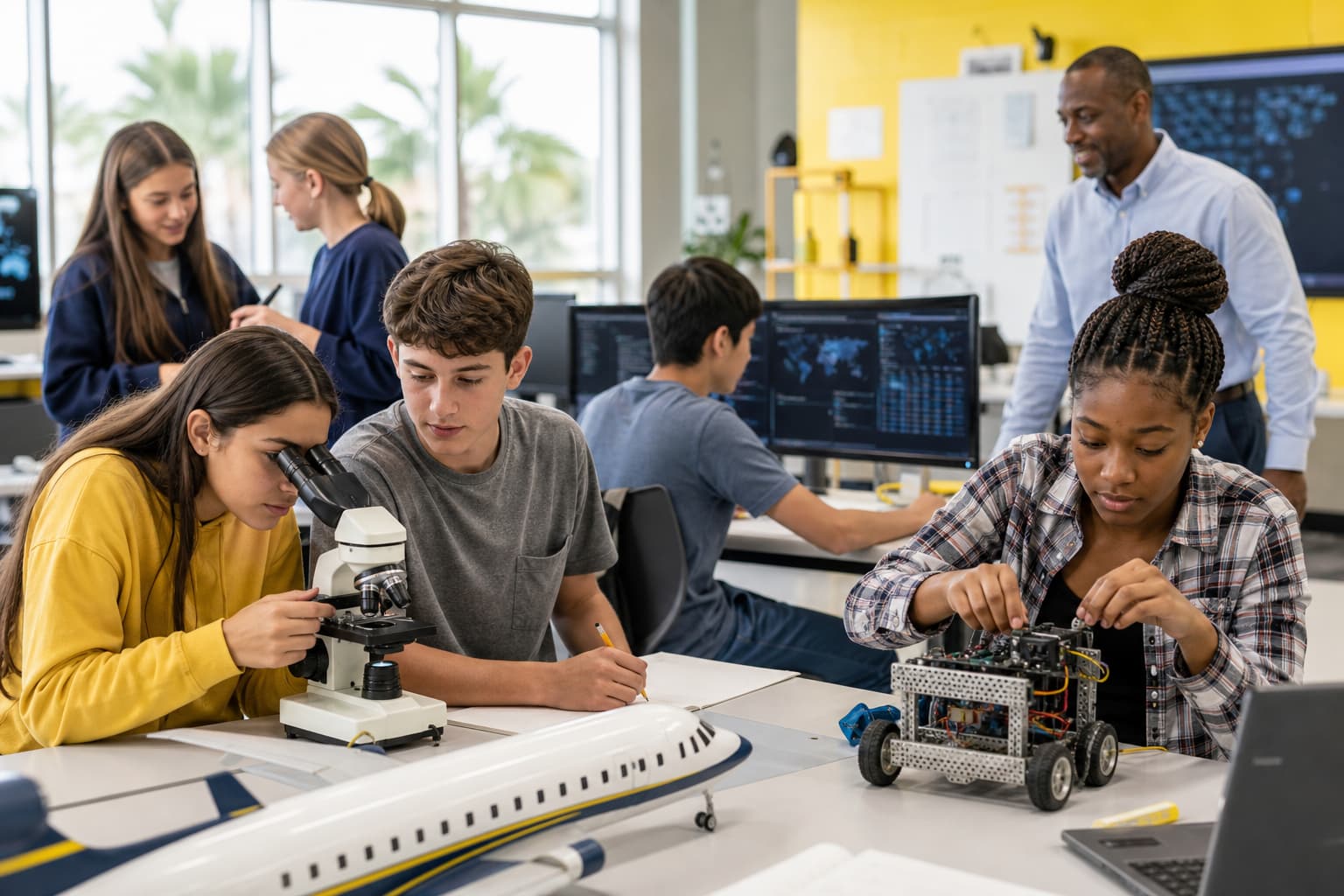
Florida education is moving in several directions at once
This week’s Florida education news reflects a familiar challenge: schools and colleges are being asked to prepare students for new opportunities while also making difficult decisions about standards, safety, funding, and facilities.
For families, the most useful takeaway is that education choices are becoming more connected to a student’s future plans. College rankings matter, but so do career programs, technical training, course access, and the quality of the support available along the way.
Florida universities receive national attention
Several Florida universities placed among the top 100 institutions on WalletHub’s 2027 list of the best colleges and universities in the country. According to the reporting summarized by Florida Trend, WalletHub compared 738 higher-education institutions using 30 measures, including selectivity, career outcomes, cost and financing, student-faculty ratio, graduation rate, and median salary after attendance.
A ranking can be a helpful starting point for families, but it should not make the decision by itself. Students should also consider the program they intend to study, total cost, financial aid, location, campus support, and whether the institution offers a realistic path to graduation. A strong overall ranking does not automatically mean a school is the best fit for every student.
Science standards remain under review
Florida’s K-12 science standards are being rewritten and have entered a public review process. The standards have not been updated since 2008, and the Board of Education is expected to vote on them in December, according to the supplied reporting.
The process has drawn criticism from the National Center for Science Education. Education Commissioner Henry Mack addressed the initiative during a Board of Education meeting, where officials discussed concerns about how the proposed standards should be understood.
This matters in practical terms. Standards influence what students are expected to learn, what teachers plan, and how families understand progress from one grade to the next. When standards change, teachers need clear guidance and sufficient time to prepare lessons and assessments. Students also benefit when science instruction emphasizes a coherent progression of knowledge rather than disconnected topics.
Families may want to follow the public review and eventual vote, especially if their children are approaching a transition between elementary, middle, and high school science courses.
Cybersecurity and workforce programs create earlier pathways
Florida Virtual School has introduced Advanced Placement Career Kickstart Cybersecurity for the 2026-27 school year. The course is described as equivalent to a one-semester college-level cybersecurity course, and more than 600 students have enrolled so far this school year.
The course reflects a broader effort to introduce career possibilities before students reach college. Cybersecurity can be a useful option for students interested in technology, problem-solving, digital systems, and protecting information. As with any advanced course, students will need to understand the workload and any prerequisites before enrolling.
A separate five-year federal grant of $4.65 million will support the FLIGHT program, a partnership involving the University of Florida and South Florida State College. The program is intended to expand workforce education, add technology-focused programs, and create more opportunities for students in rural Florida. South Florida State College will receive about $3.29 million, while UF will receive more than $1.35 million.
Eastern Florida State College has also opened an Aerospace Center of Excellence at its Titusville campus. The center includes workbenches, mechanical laboratories, aviation simulators, and airplane engines as part of an expanded aerospace technology program.
Together, these developments show why students should look beyond traditional four-year college routes. Dual-credit courses, career-focused classes, community college programs, and hands-on technical training may all help students explore possible careers before committing to a long-term plan.
Local decisions will affect school communities
Pinellas County’s school board approved closing six under-capacity campuses while continuing to review the future of Sexton Elementary. These decisions are described as part of the district’s effort to address long-term financial concerns.
School closures affect more than enrollment numbers. They can change transportation times, routines, neighborhood connections, and the support students receive during a transition. Families should look for clear information about timelines, transportation, enrollment, and services for students who need additional support.
South Florida districts are also preparing for a November 3 vote on renewing a property-tax supplement that has supported teacher pay, school safety, and mental health resources. Education leaders are concerned that voters could confuse the renewal measure with Amendment 3, which the supplied reporting describes as a controversial proposal involving property taxes used for public services.
These stories are reminders that education policy becomes real in classrooms and households. Students need strong instruction and meaningful opportunities, but they also need clear communication when systems change. Families can help by asking specific questions, reviewing official information, and focusing on the options that best match a student’s learning needs and goals.