What Kentucky’s New School Report Cards Mean for Families
Kentucky has released school performance ratings for the 2025–26 academic year. Here is what families should understand about the color-coded results—and how to use them thoughtfully.
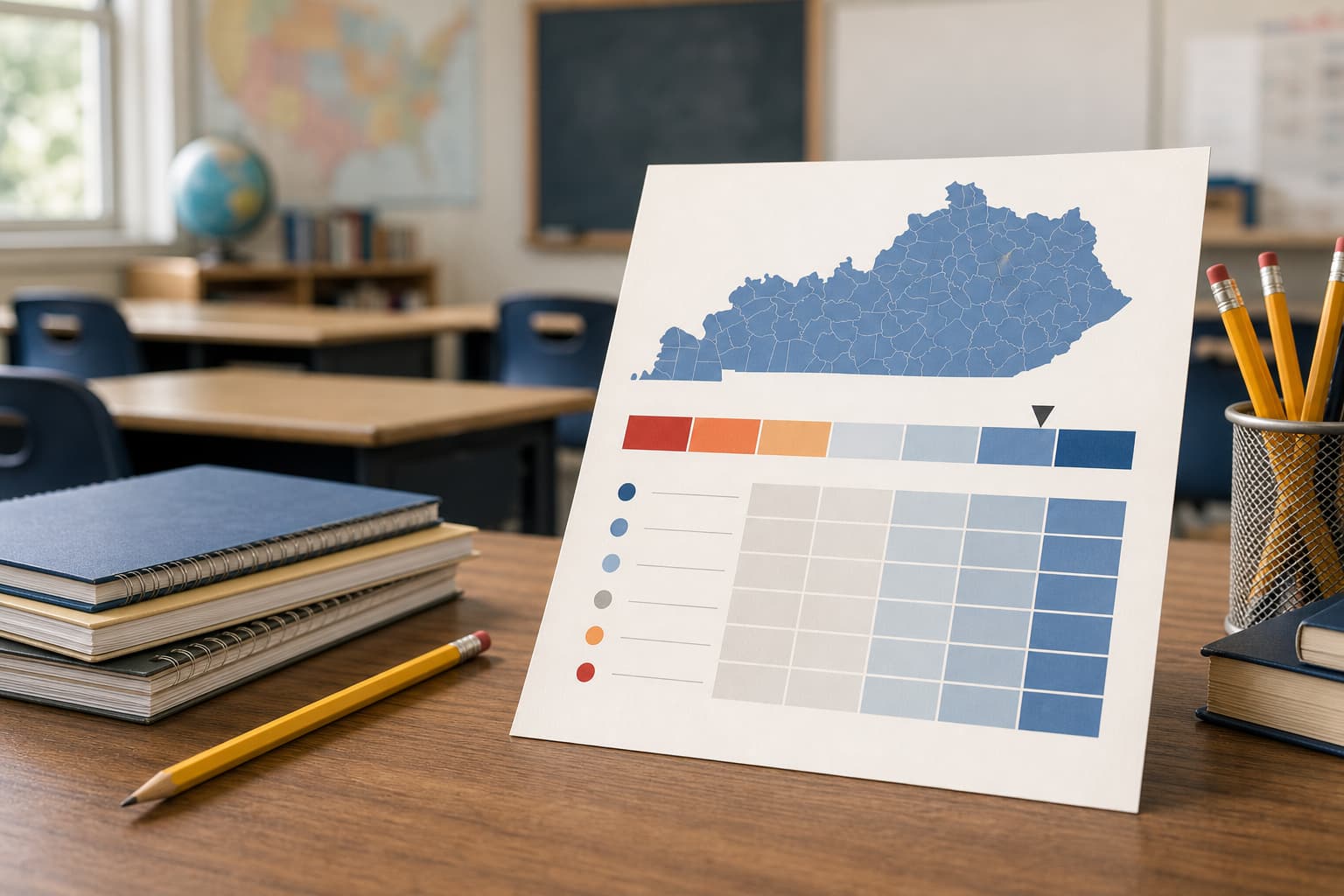
Kentucky releases 2025–26 school ratings
The Kentucky Department of Education has released school report cards for districts across the state. The ratings are based on the 2025–26 academic year and use a color scale ranging from red, representing the lowest performance, to blue, representing the highest performance.
The report offers families a quick way to see how schools performed across elementary, middle, and high school levels. It also shows why it is important to look at a district by school level rather than assuming that every school in a district received the same rating.
Northern Kentucky results vary by school and grade level
Several Northern Kentucky districts received strong ratings across their schools. Fort Thomas Independent received blue ratings for its elementary, middle, and high schools. Beechwood Independent received blue ratings at the elementary and middle school levels and a green rating at the high school level.
Boone County, Campbell County, Grant County, Kenton County, and Walton-Verona Independent received green ratings across their elementary, middle, and high schools. Pendleton County received yellow ratings at the elementary and middle school levels and a green rating at the high school level.
Other districts showed more variation. Bellevue Independent received a green rating for elementary schools and yellow ratings for middle and high schools. Mason County received a yellow rating for elementary schools and orange ratings for middle and high schools. Dayton Independent and Gallatin County each received an orange elementary rating and yellow ratings for middle and high schools.
The report also identifies districts with lower ratings in particular school levels. Covington Independent received a yellow elementary rating, an orange middle school rating, and a red high school rating. Newport Independent received a red elementary rating and orange middle and high school ratings.
Bracken County received yellow ratings across all three levels, while Owen County received orange ratings at the elementary and middle school levels and a yellow rating at the high school level. The article also reports green ratings across all three levels for Boone, Campbell, Grant, Kenton, and Walton-Verona counties.
How families can use the information
A color rating can be a useful starting point, but it should not be the only information a family considers. Students have different strengths, needs, and goals, and a school’s overall rating cannot describe every classroom or every student experience.
Families can use the report cards to begin more focused conversations. For example, a parent might ask what factors contributed to a school’s rating, how the school is supporting students who need additional help, or which academic areas are receiving the most attention.
Students can also benefit from understanding the results without viewing a rating as a personal judgment. A school’s performance rating describes school-level outcomes; it does not define an individual student’s ability or potential.
For teachers and tutors, the report cards may provide a useful prompt for reviewing academic priorities. If a student is struggling in a particular subject, instruction can focus on building the underlying skills that support progress rather than reacting only to the school’s overall color.
A starting point, not a final conclusion
Kentucky’s report cards give communities a common set of school-level performance information. The most useful next step is to examine the results carefully and pair them with questions about student support, academic growth, and the needs of individual learners.
For families, the report is best used as one piece of a larger decision-making process. It can help identify where to look more closely, what questions to ask, and where students may need additional encouragement or support.