What AI’s Math Proofs Mean for Learning
Reports that AI systems have produced advanced mathematical proofs are raising difficult questions about research, teaching, and the value of learning through struggle.
A new source of anxiety in mathematics
A recent Boston Globe report describes growing concern at MIT after OpenAI announced that its artificial intelligence agents had solved a famous problem involving the Navier-Stokes equations and produced proofs for nearly 400 other previously unsolved problems. The accuracy and significance of those proofs still need to be evaluated, but the announcement has already affected how mathematicians think about their work and their futures.
For graduate students, the concern is especially immediate. A survey of MIT’s mathematics department received 45 responses from 120 graduate students. Among those respondents, three out of four said they feared AI would make tenure-track jobs harder to obtain, while 71 percent said they were considering a change in direction because their chances of continuing in academic mathematics seemed lower.
These reactions are not simply about employment. They are also about what makes mathematics meaningful in the first place.
The value of working through a problem
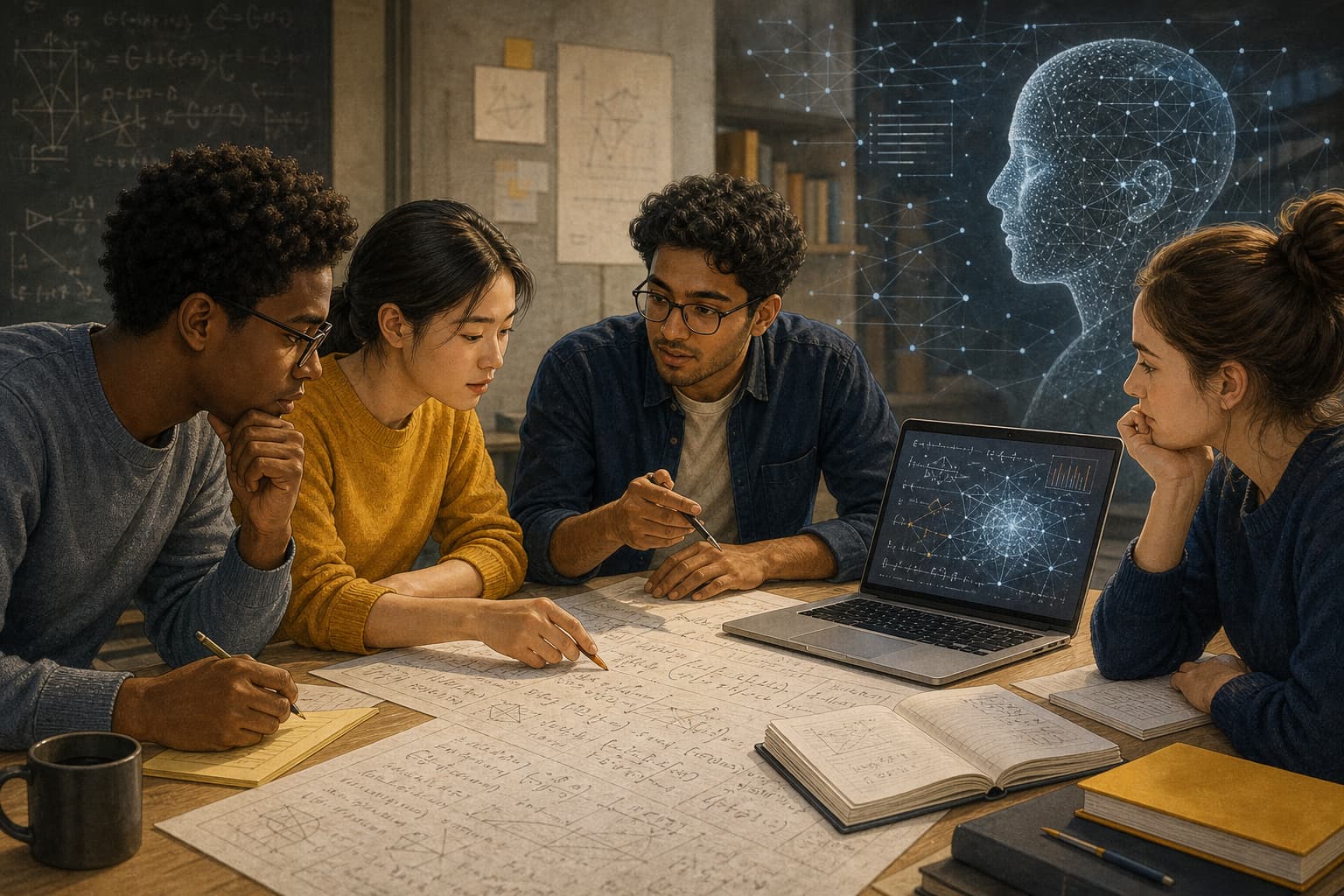
The report describes students worrying that mathematics could become less collaborative and more like a race against increasingly capable software. Undergraduates, too, are finding it harder to gather around challenging problem sets when tools such as ChatGPT and Claude can provide answers quickly.
That shift matters because solving a difficult problem is not only about reaching the final answer. Students develop mathematical judgment by trying an approach, finding where it fails, explaining their reasoning, and revising their work. They learn to recognize patterns, ask better questions, and persist when the solution is not obvious.
An AI-generated answer may be useful, but it does not automatically provide those experiences. The article describes a calculus student who relied on ChatGPT’s method before checking whether the solution was correct. A graduate student then had to work through the problem and defend the mathematics against the chatbot’s recommendation. That example illustrates a central challenge: students still need enough understanding to evaluate an answer, even when a tool produces one instantly.
A changing role for teachers and mathematicians
MIT has asked faculty and students to consider how AI should affect teaching, research, and learning. The university now requires course syllabi to include policies explaining when AI may be used. Other universities are also developing rules, while some are choosing stricter limits on technology in classrooms.
The most useful policies will likely distinguish between different purposes. Using AI to generate practice questions, offer a hint, or provide another explanation may support learning. Using it to complete an assignment without understanding the reasoning may remove the very practice the assignment was designed to provide.
The Boston Globe report also describes one MIT professor’s view that mathematicians may increasingly become interpreters and communicators rather than people who complete every technical step themselves. That possibility offers a constructive direction. If AI becomes better at producing proofs, students may need even stronger preparation in explaining why a proof works, identifying hidden assumptions, checking errors, and connecting abstract ideas to meaningful problems.
Those are not lesser skills. They are demanding forms of mathematical thinking.
What families and students can take from this
For students, the practical lesson is not to reject every AI tool or to accept every answer. It is to use technology in ways that preserve the work of learning. Before asking for a complete solution, a student might request a hint, test a proposed step, or ask for an explanation of a specific concept. After receiving help, the student should be able to solve a similar problem independently and explain the reasoning without the tool.
Families can also ask a simple question: Is the technology helping the student think, or replacing the thinking? A correct-looking answer is not evidence that learning has occurred.
Teachers and tutors have an important role in creating spaces where struggle is normal and productive. Students need opportunities to compare strategies, discuss mistakes, and experience the satisfaction of reaching an answer through their own reasoning. In a period of rapid technological change, those human learning experiences may become more valuable, not less.
The reported AI breakthroughs raise serious questions about the future of mathematical research. But for today’s learners, the priority remains clear: build the understanding and confidence needed to judge any answer—including one produced by a powerful machine.