Calculus visual reference
Common Derivatives Chart
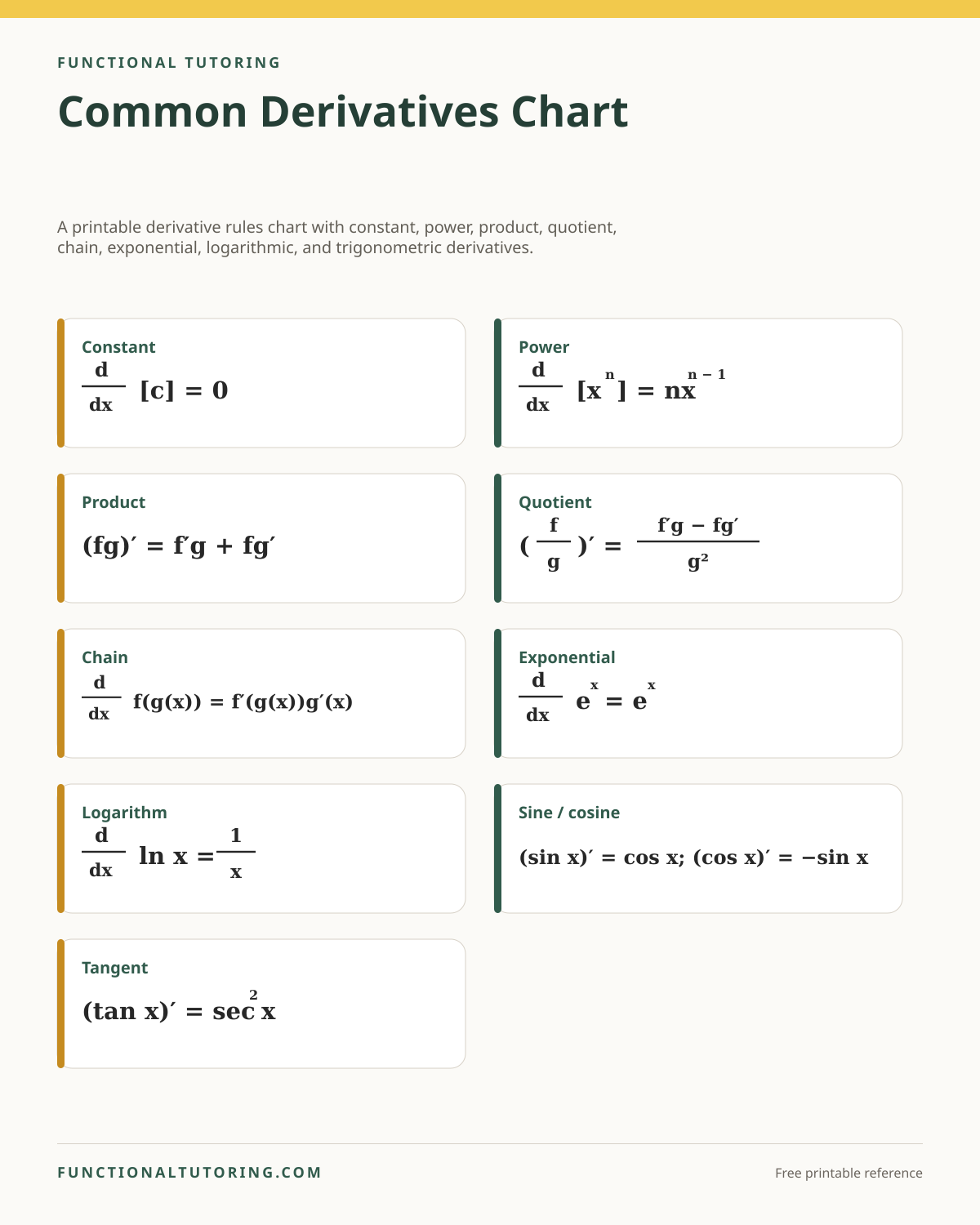
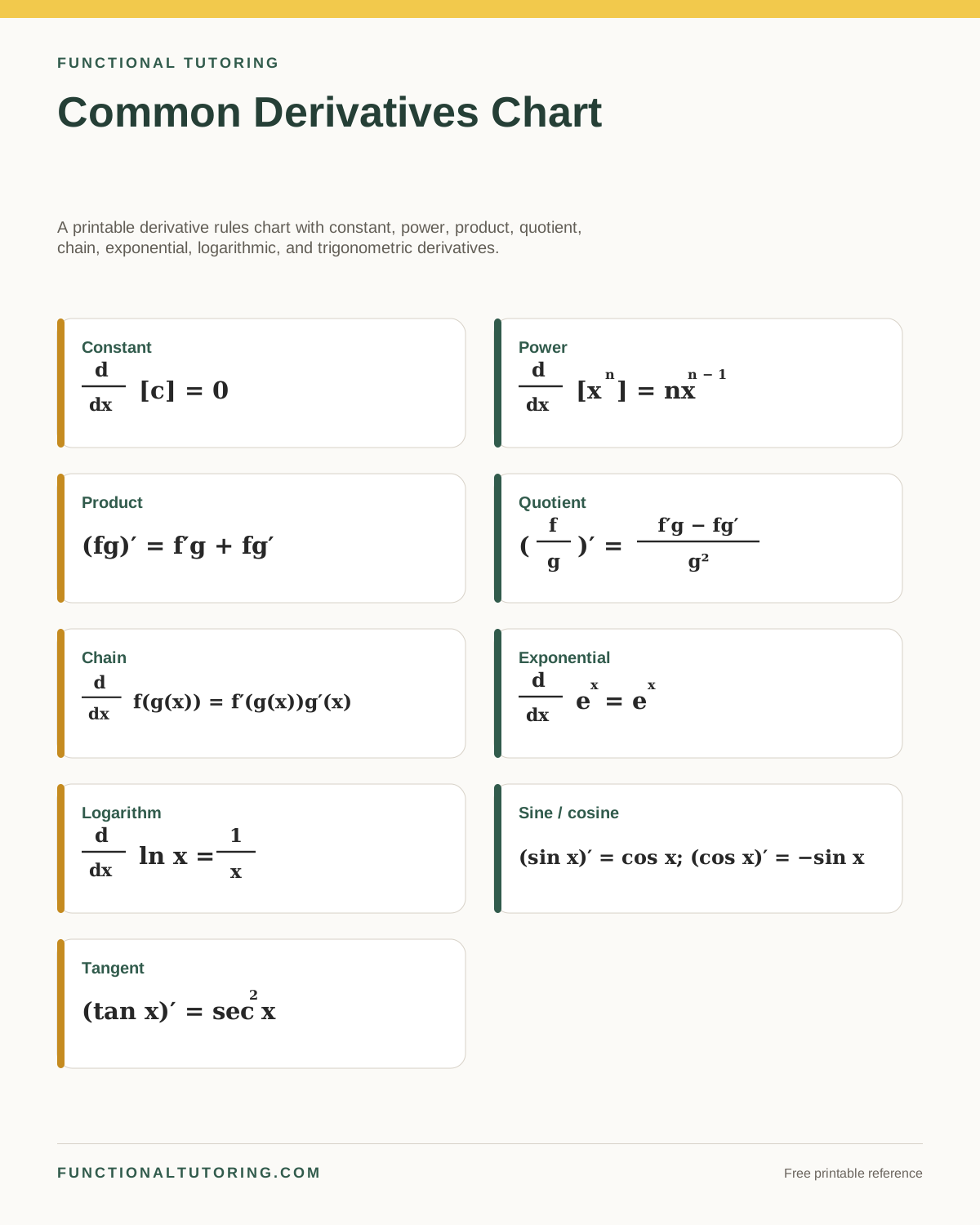
A derivative rule tells you how a function's output changes as its input changes. Identify the outer structure first—sum, product, quotient, or composition—then apply the matching rule.

How to read it
Use the chart as a decision tool.
A printable derivative rules chart with constant, power, product, quotient, chain, exponential, logarithmic, and trigonometric derivatives. Read the label first, identify the matching structure in your problem, then confirm that any stated conditions apply before substituting values.
Core rules
These rules combine to differentiate larger expressions.
Power
Product
Quotient
Chain
Common functions
Assume each expression is in its differentiable domain.
Exponential
Logarithm
Sine / cosine
Tangent
How to remember it
Name the outer operation first
- 1Sums differentiate term by term.
- 2Products and quotients need their own rules; do not differentiate each factor separately.
- 3A composition signals the chain rule: outside derivative times inside derivative.