Free printable worksheet
DNA Structure Worksheet
Twelve quantitative dna structure problems using biological data, ratios, probabilities, and rates.
BiologyGrades 7-124 pagesAnswer key included
No email is required. Download the complete worksheet and answer key now.
Download the free PDF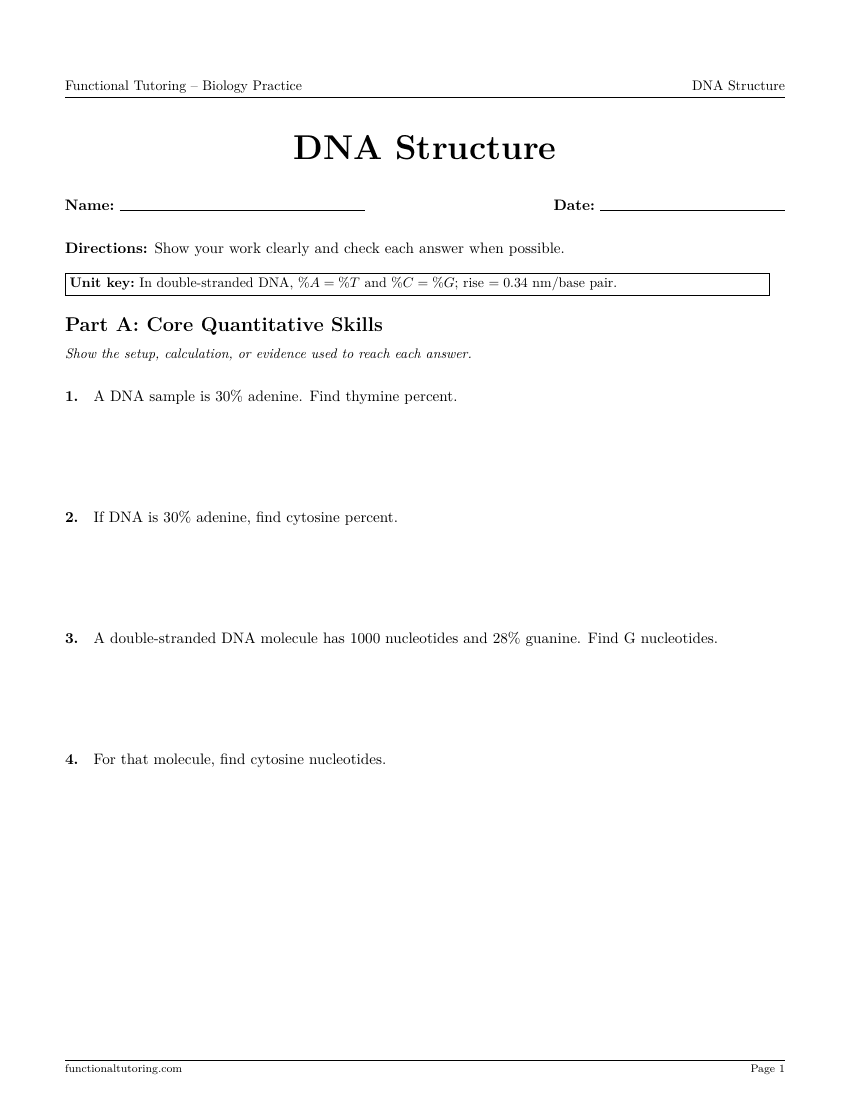
What this worksheet includes
- Twelve quantitative dna structure problems using biological data, ratios, probabilities, and rates.
- 4-page printable PDF with a complete answer key
- Designed for Grades 7-12 biology practice
- Available as an immediate free download with no email required
How to use it
Use this dna structure worksheet for guided practice, independent review, homework, tutoring sessions, or a quick skills check. The spacious layout is designed to leave room for students to show their work rather than guess from crowded answer choices.
After students finish, compare their reasoning with the included answer key. When an answer is incorrect, have the student locate the first step where their work changed direction before trying the problem again.
Who this practice is for
This resource is designed for grades 7-12 students working on biology. Teachers, tutors, homeschool families, and parents can preview the first page before deciding whether the level and spacing fit the student.
Looking for a broader sequence? Browse all Biology worksheets.
Topic guide
How to approach dna structure
DNA Structure becomes easier when students translate the given data into a measurable relationship before calculating. Twelve quantitative dna structure problems using biological data, ratios, probabilities, and rates.
This biology worksheet replaces definition recall with quantitative evidence. Students calculate counts, proportions, probabilities, rates, and changes, then connect the result to the biological process being studied.
Learning objectives
- Analyze numerical data connected to dna structure
- Calculate biological counts, ratios, probabilities, rates, and percent changes
- Interpret a numerical result in the context of a biological process
Skills to review first
- Core scientific relationships connected to dna structure
- Fractions, percentages, ratios, and one-variable calculations
- Reading units, tables, formulas, and scientific notation
Worked example
Follow the reasoning step by step
Solve one representative quantitative dna structure problem from Part A.
- List the given data and identify the requested quantity.
- Choose the relationship, ratio, probability rule, or conversion that connects them.
- Substitute carefully and carry units or labeled counts through the calculation.
- Check the scale of the result and explain what it means scientifically.
Solution: A complete solution includes the setup, calculation, labeled result, and a brief scientific interpretation when appropriate.
Try before downloading
Three sample problems
Work each problem, then open the answer to check your result.
Find the length of base pairs using per pair.
Show answer
A replication error rate is per bases. Estimate errors in bases.
Show answer
Error check
Common mistakes to watch for
- Using the wrong total as the denominator in a percentage or frequency
- Confusing chromosome, cell, nucleotide, organism, or population counts
- Calculating correctly but not connecting the value to the biological situation