Algebra visual reference

Factoring Patterns Cheat Sheet

Factoring reverses multiplication. Always look for a greatest common factor first, then compare the remaining polynomial with a recognizable pattern and multiply back to verify.
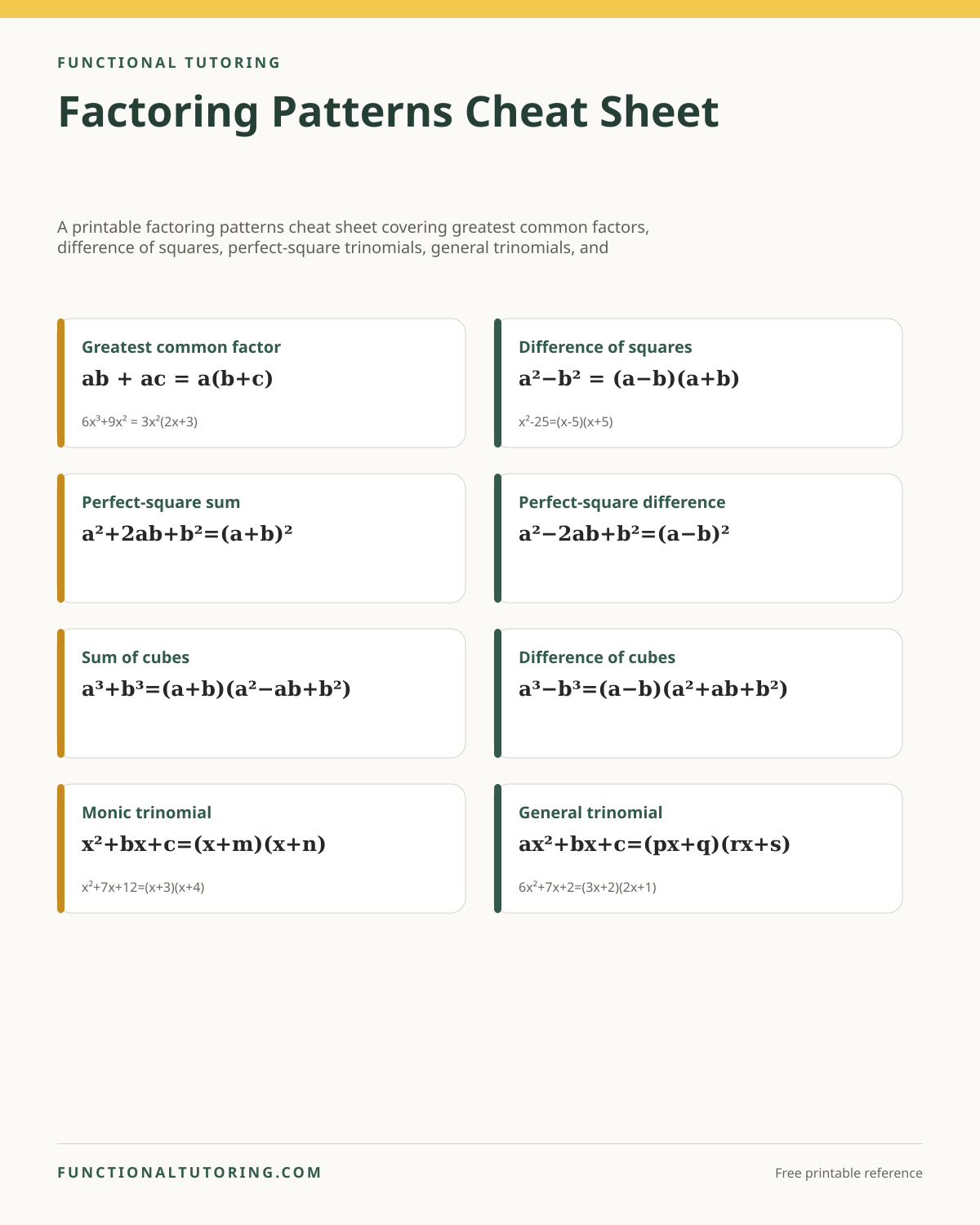
Factoring patterns cheat sheet with greatest common factor difference of squares perfect square trinomial general trinomial and cube formulas plus examples
Open the chart for a full-size, printable version.
How to read it

Use the chart as a decision tool.

A printable factoring patterns cheat sheet covering greatest common factors, difference of squares, perfect-square trinomials, general trinomials, and cubes. Read the label first, identify the matching structure in your problem, then confirm that any stated conditions apply before substituting values.

01

Start here

Remove every factor shared by all terms.

Greatest common factor

ab+ac=a(b+c)\displaystyle ab+ac=a(b+c)

Example: 6x3+9x2=3x2(2x+3)\displaystyle 6x^3+9x^2=3x^2(2x+3)

02

Special products

These patterns factor immediately when every condition matches.

Difference of squares

a2b2=(ab)(a+b)\displaystyle a^2-b^2=(a-b)(a+b)

Example: x225=(x5)(x+5)\displaystyle x^2-25=(x-5)(x+5)

Perfect-square sum

a2+2ab+b2=(a+b)2\displaystyle a^2+2ab+b^2=(a+b)^2

Perfect-square difference

a22ab+b2=(ab)2\displaystyle a^2-2ab+b^2=(a-b)^2

Sum of cubes

a3+b3=(a+b)(a2ab+b2)\displaystyle a^3+b^3=(a+b)(a^2-ab+b^2)

Difference of cubes

a3b3=(ab)(a2+ab+b2)\displaystyle a^3-b^3=(a-b)(a^2+ab+b^2)
03

Trinomials

Use multiplication to verify the middle term.

Monic trinomial

x2+bx+c=(x+m)(x+n)\displaystyle x^2+bx+c=(x+m)(x+n)

Example: x2+7x+12=(x+3)(x+4)\displaystyle x^2+7x+12=(x+3)(x+4)

General trinomial

ax2+bx+c=(px+q)(rx+s)\displaystyle ax^2+bx+c=(px+q)(rx+s)

Example: 6x2+7x+2=(3x+2)(2x+1)\displaystyle 6x^2+7x+2=(3x+2)(2x+1)

How to remember it

GCF first, pattern second, multiply to check

  1. 1A difference of squares must have subtraction and two perfect squares.
  2. 2Perfect-square trinomials have matching outer squares and twice their product in the middle.
  3. 3For ax²+bx+c, the inner and outer products must combine to b.