Algebra visual reference
Quadratic Formula Guide
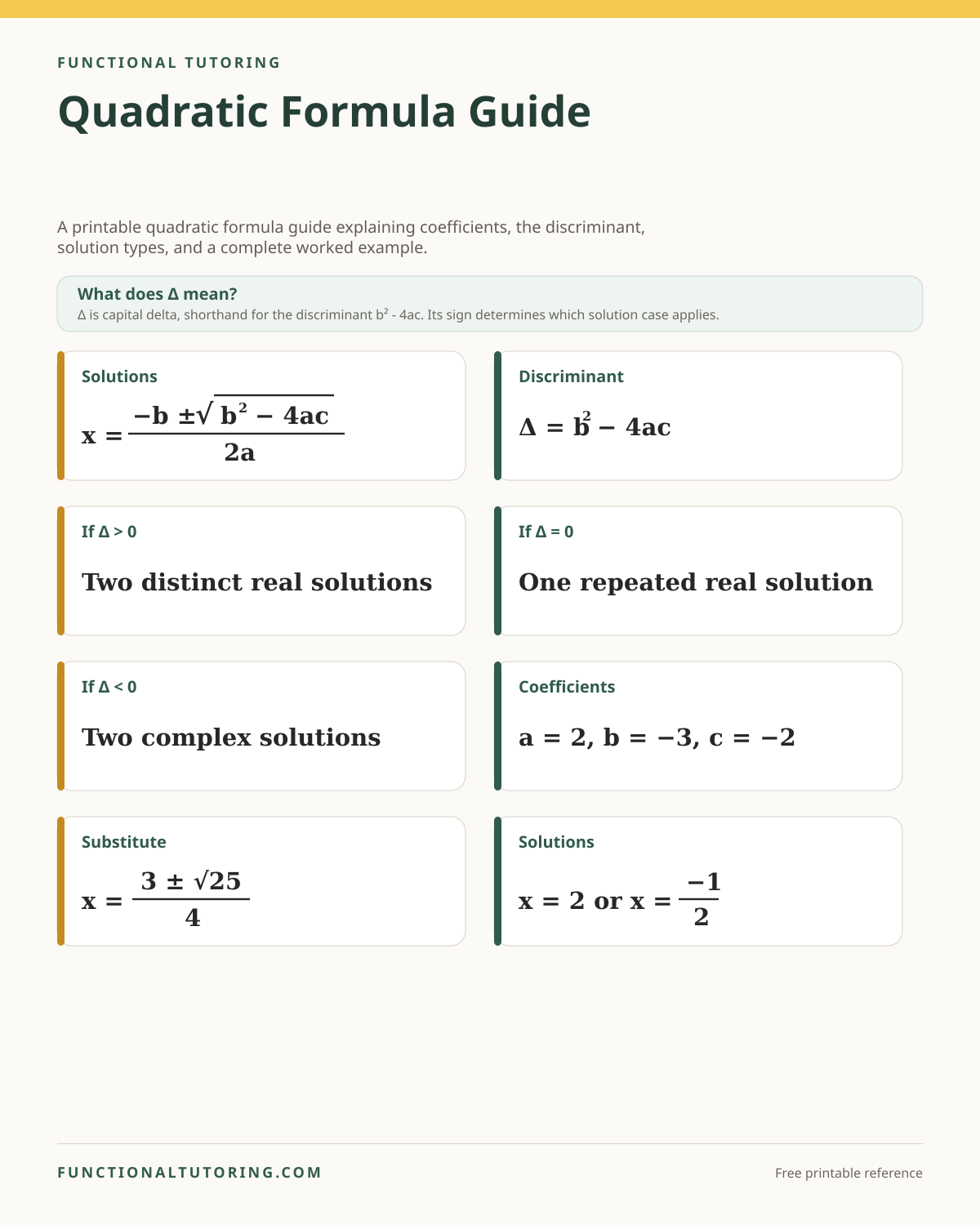
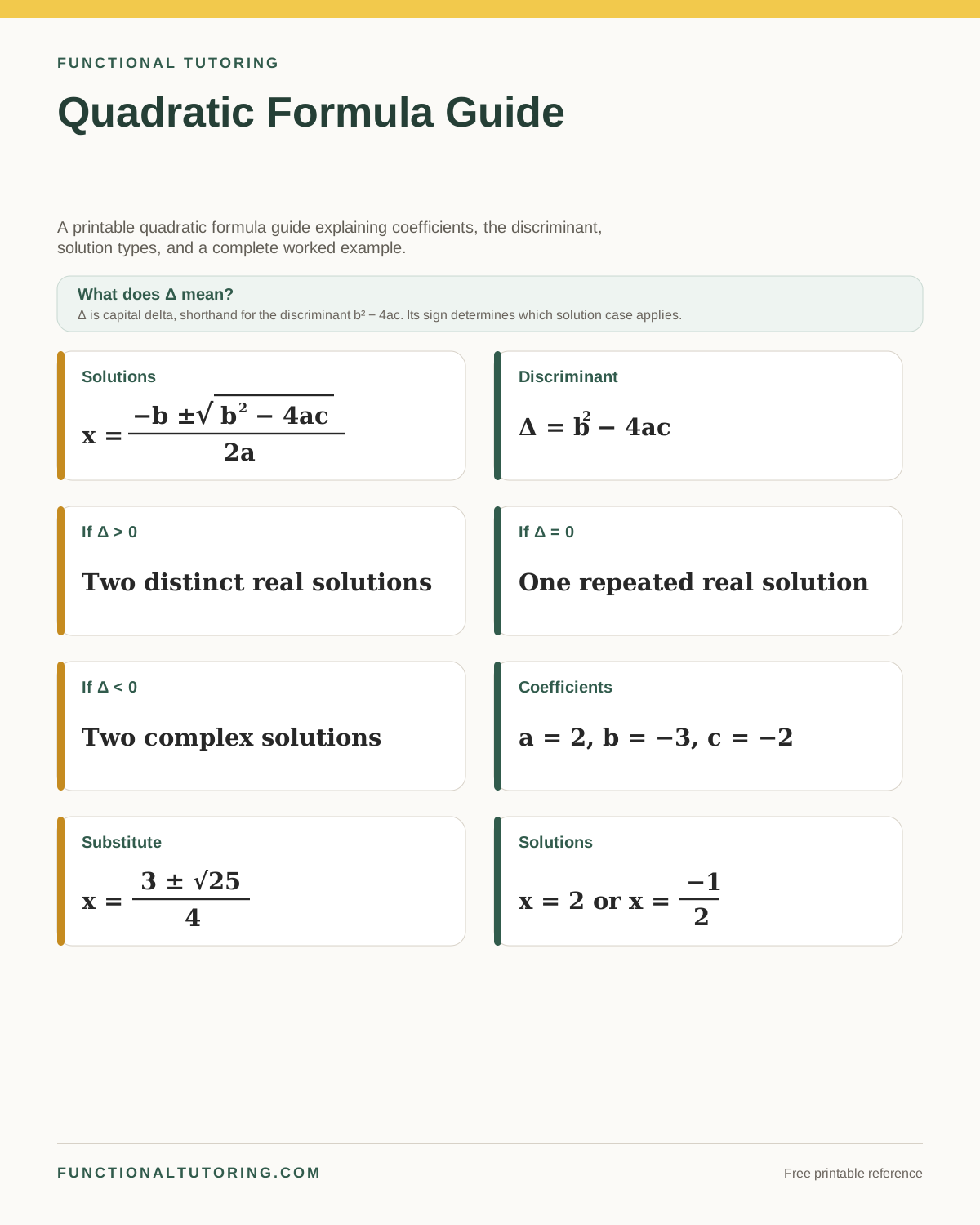
The quadratic formula solves every equation in standard form ax² + bx + c = 0 when a is not zero. Keeping the entire numerator over 2a prevents the most common substitution error.

How to read it
Use the chart as a decision tool.
A printable quadratic formula guide explaining coefficients, the discriminant, solution types, and a complete worked example. Read the label first, identify the matching structure in your problem, then confirm that any stated conditions apply before substituting values.
The formula
For ax² + bx + c = 0 with a ≠ 0.
Discriminant
What the discriminant says
Δ (capital delta) is the discriminant b² − 4ac. Its sign classifies the roots before you finish.
If Δ > 0
If Δ = 0
If Δ < 0
Worked example
Solve 2x² − 3x − 2 = 0.
Coefficients
Substitute
Solutions
How to remember it
Write standard form before substituting
- 1Move every term to one side so the other side is zero.
- 2Copy a, b, and c with their signs.
- 3Put −b ± √(b²−4ac) together over the full denominator 2a.