f(x) = 2x − 5; find f(4)
Show answer
3
Thirty-two evaluations across eight linear, quadratic, absolute value, radical, exponential, rational, cubic, and piecewise rules.
No email is required. Download the complete worksheet and answer key now.
Download the free PDF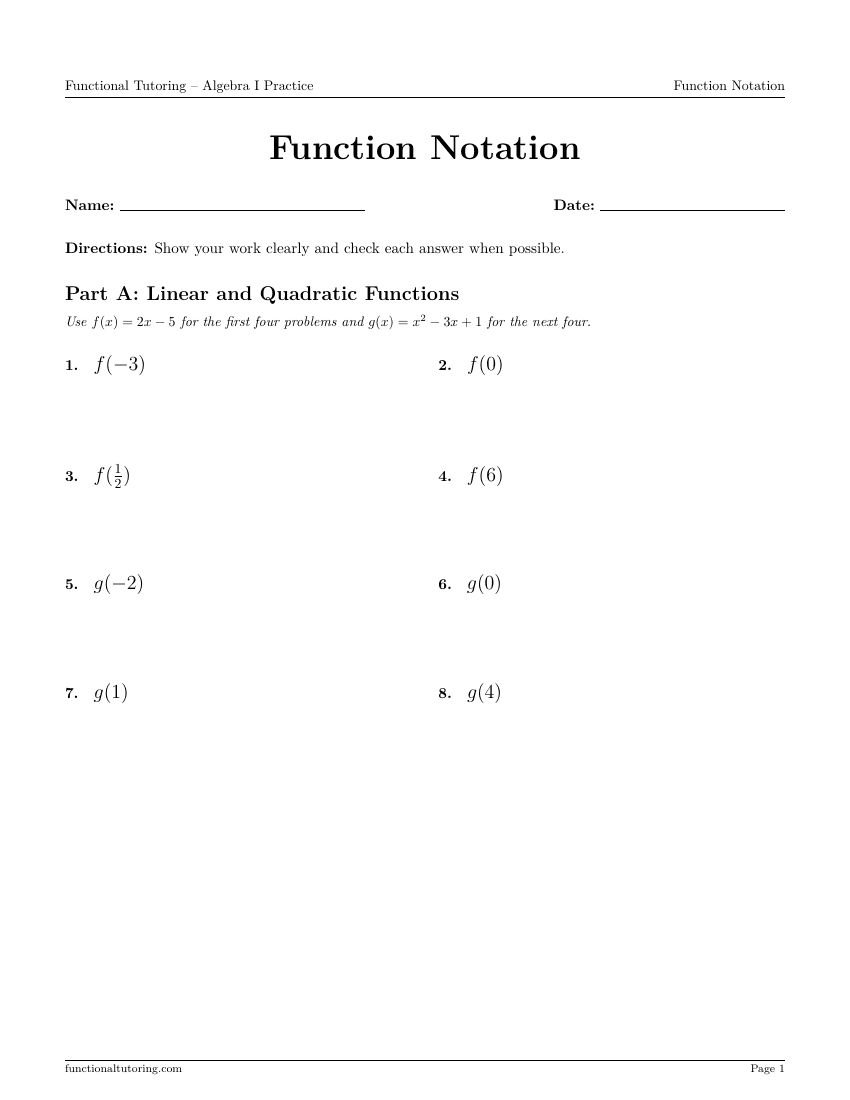
Use this function notation worksheet for guided practice, independent review, homework, tutoring sessions, or a quick skills check. The spacious layout is designed to leave room for students to show their work rather than guess from crowded answer choices.
After students finish, compare their reasoning with the included answer key. When an answer is incorrect, have the student locate the first step where their work changed direction before trying the problem again.
This resource is designed for grades 7-10 students working on algebra 1. Teachers, tutors, homeschool families, and parents can preview the first page before deciding whether the level and spacing fit the student.
Looking for a broader sequence? Browse all Algebra I worksheets.
Function notation such as f(3) asks for the output when the input is 3. Replace every x in the rule with the given input, use parentheses around negative inputs, and then follow the order of operations.
The worksheet moves across linear, quadratic, absolute-value, radical, exponential, rational, cubic, and piecewise functions so students practice the notation rather than memorizing one function pattern.
If g(x) = x² − 3x + 1, find g(−2).
Solution: g(−2) = 11.
Work each problem, then open the answer to check your result.
3
3
3