Functions visual reference
Parent Functions Chart
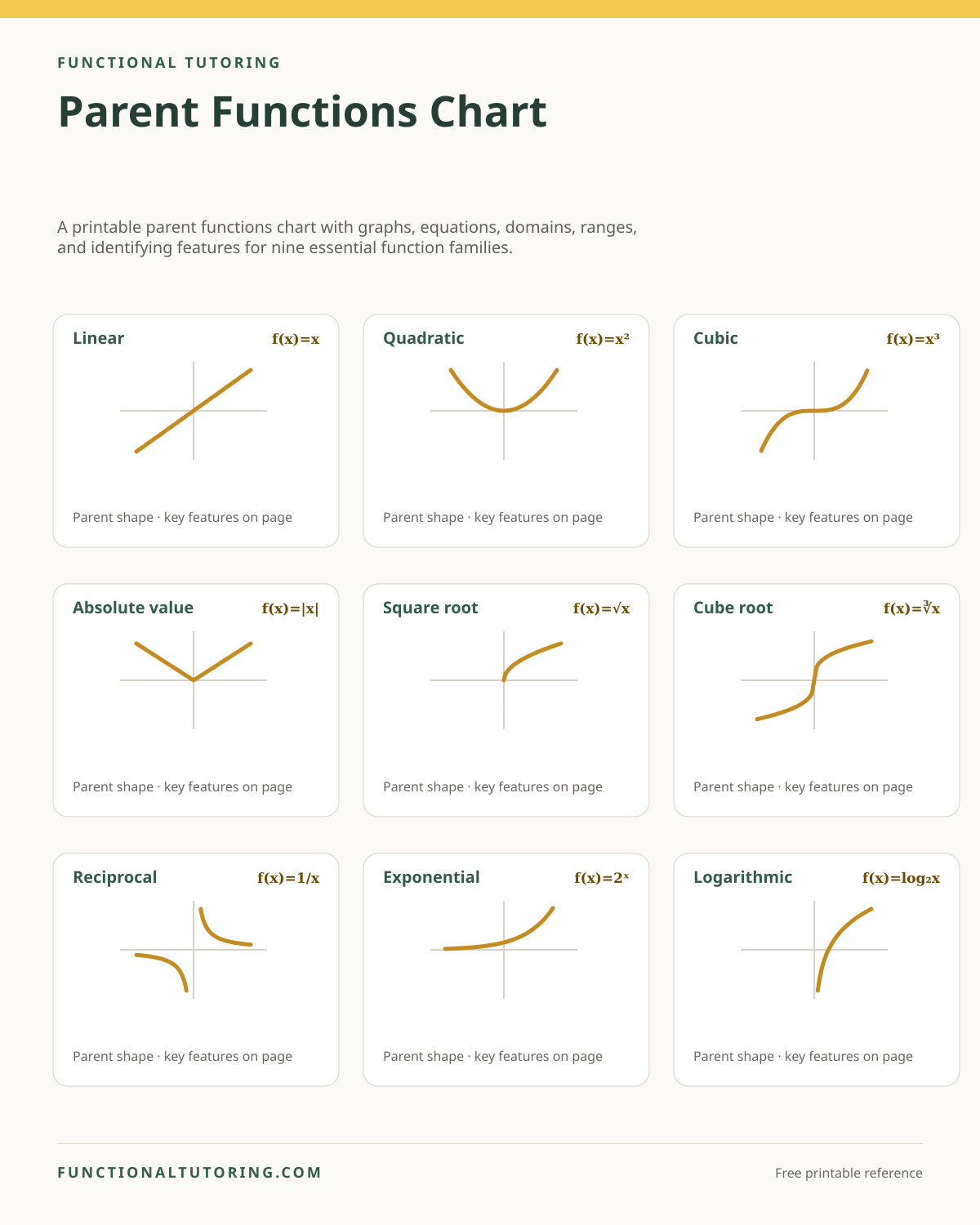
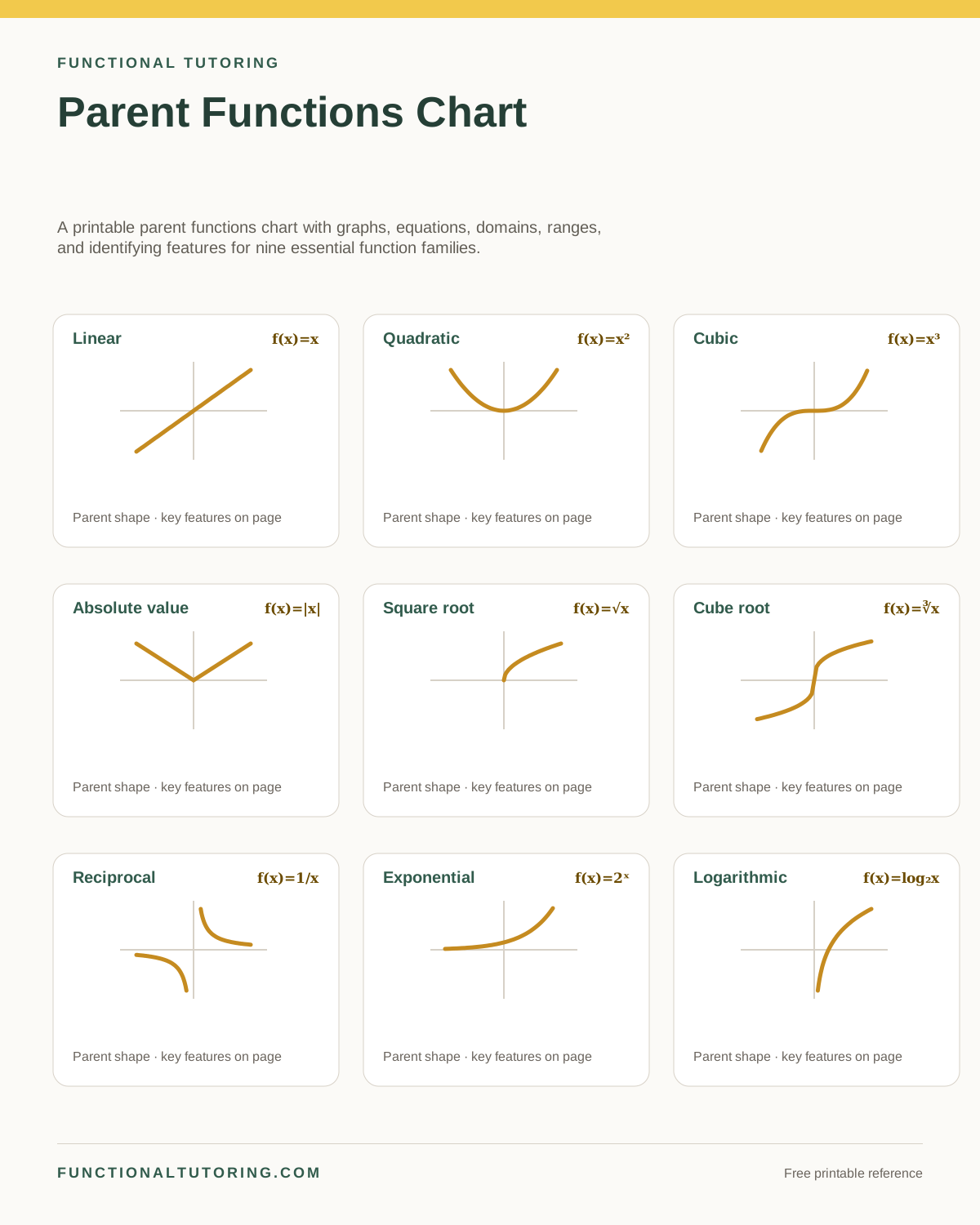
A parent function is the simplest member of a function family. Recognizing its shape makes transformations, domain, range, intercepts, symmetry, and end behavior much easier to predict.

How to read it
Use the chart as a decision tool.
A printable parent functions chart with graphs, equations, domains, ranges, and identifying features for nine essential function families. Read the label first, identify the matching structure in your problem, then confirm that any stated conditions apply before substituting values.
Polynomial and piecewise shapes
These are defined for every real input.
Quadratic
Cubic
Absolute value
Radical and rational shapes
Watch endpoints and excluded inputs.
Square root
Cube root
Reciprocal
Inverse growth families
Exponential and logarithmic functions are inverses.
Exponential
Logarithmic
How to remember it
Identify the shape before reading the shifts
- 1Lines have constant rate of change; parabolas have a turning point.
- 2Absolute value makes a V; square root begins at an endpoint.
- 3Reciprocal, exponential, and logarithmic parents have asymptotes.